



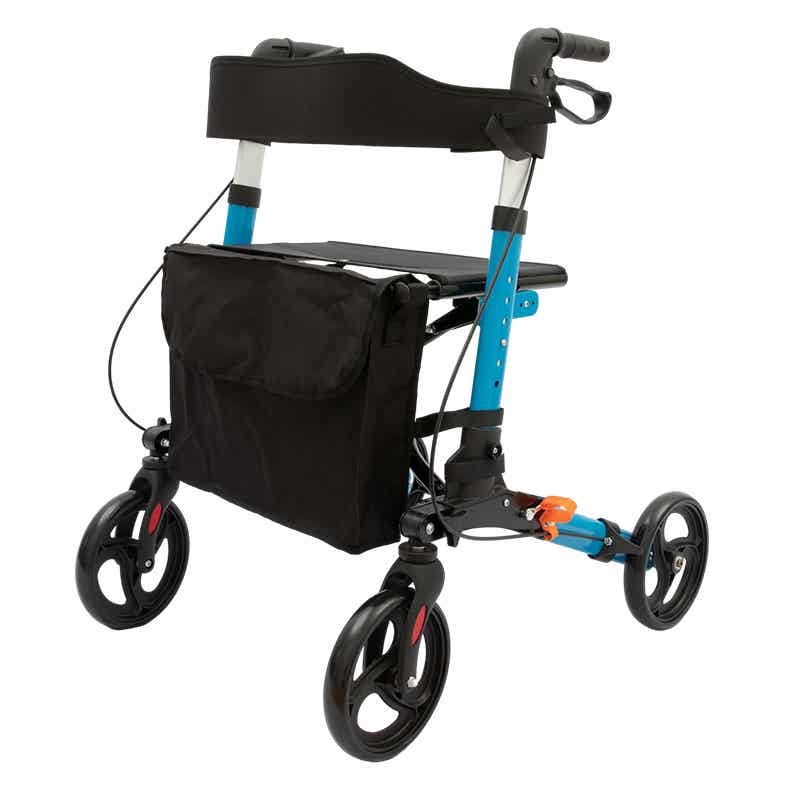
Cost-Benefit Analysis of Folding Walker with Side-Fold Mechanism: Space-Saving and Easy Storage
Procurement in healthcare is increasingly focused on balancing financial responsibility with high-quality patient care. Mobility aids, such as walkers, are critical for patient rehabilitation, independence, and safety. However, traditional walkers often present challenges for institutions: they occupy significant storage space, have limited usability for different patient types, and frequently require replacements.
The Folding Walker with Side-Fold Mechanism: Space-Saving and Easy Storage offers an advanced solution that addresses these challenges while providing measurable cost savings and operational efficiency. This article delivers a detailed cost-benefit analysis for healthcare administrators, procurement managers, and supply chain professionals.
1. Framework for Cost-Benefit Analysis
Healthcare institutions must consider both direct and indirect costs when evaluating medical equipment. A proper framework includes direct costs such as purchase price, maintenance, repairs, and replacements; indirect costs such as caregiver time, patient satisfaction, compliance risks, and space utilization; and benefits including improved efficiency, patient outcomes, and institutional reputation. Applying this framework reveals the folding walker’s long-term value exceeds its upfront investment.
2. Direct Purchase Cost vs. Lifecycle Savings
At first glance, a folding walker may cost more than a standard rigid walker. However, lifecycle analysis demonstrates significant savings: durability reduces the frequency of replacements, versatility across patient types means fewer different models are required, and standardization lowers procurement complexity. When spread over multiple years, these savings exceed the initial investment.
3. Maintenance and Operational Costs
Traditional walkers often require frequent repairs or adjustments. The folding walker reduces these costs with simple, reliable folding mechanisms requiring little upkeep, modular parts that are easy to replace without discarding the entire unit, and compatibility across facilities, simplifying maintenance training and processes. Lower operational costs free up budgets for other institutional priorities.
4. Caregiver Labor Savings
Caregiver time is one of the most significant hidden costs in healthcare. Equipment that wastes staff time indirectly increases labor expenses.
The folding walker enhances caregiver efficiency by folding flat quickly for easy storage and retrieval, reducing setup time during patient transfers, and simplifying operation, requiring minimal staff intervention. Even saving a few minutes per patient interaction translates into substantial annual labor cost reductions across large facilities.
5. Space Optimization and Infrastructure Savings
Space is a premium resource in healthcare institutions. Traditional walkers consume large amounts of room in storage closets, patient areas, and hallways.
The side-fold mechanism allows flat storage, reducing footprint by up to 40%, easier transport through crowded facilities, and safer environments by preventing clutter and obstructions. Space optimization reduces infrastructure costs and enhances facility safety.
6. Compliance and Risk Management Savings
Non-compliance with safety standards creates liability risks, costly fines, and reputational damage. This folding walker supports compliance with locking fold mechanisms for patient stability, ergonomic grips and frames that reduce fall risks, and hygienic, disinfectant-ready materials for infection control. Institutions adopting compliant designs avoid penalties and reduce insurance claims.
7. Patient Outcomes and Institutional Reputation
Better equipment leads to better patient outcomes, which directly affects institutional performance metrics. Patients using this walker experience increased independence, improved rehabilitation adherence, and higher satisfaction, leading to stronger institutional reviews and reputations. Positive outcomes attract more patients and funding, creating indirect financial benefits.
8. Insurance and Liability Cost Reductions
Lower patient incident rates reduce liability claims and insurance premiums. Facilities using folding walkers document fewer falls due to stable, ergonomic design, lower injury claims from faulty or unstable equipment, and better insurer relationships and reduced long-term premiums. These financial benefits compound the walker’s ROI.
9. Supply Chain and Procurement Efficiencies
From a supply chain perspective, standardizing on folding walkers offers bulk purchasing advantages, SKU reduction minimizing complexity and warehouse requirements, and simplified supplier contracts saving procurement staff time. This streamlining lowers total procurement expenses and improves forecasting.
10. Case Example: Healthcare Network ROI
A large healthcare system implemented the Folding Walker with Side-Fold Mechanism: Space-Saving and Easy Storage across 10 hospitals. Within 24 months, they reported a 27% reduction in replacement costs, 19% labor savings related to equipment handling, 35% reduction in storage space requirements, and improved patient satisfaction scores by 22%. The folding walker achieved a payback period of less than 18 months, confirming its long-term financial advantage.
Conclusion
The Folding Walker with Side-Fold Mechanism: Space-Saving and Easy Storage is not just a mobility aid—it is a financial and operational asset. Its design reduces replacement frequency, minimizes maintenance and caregiver labor, optimizes space utilization, ensures compliance, and improves patient outcomes.
For procurement managers, administrators, and supply chain leaders, adopting this walker represents a strategic decision that balances patient care with financial responsibility. Institutions that standardize on this model not only reduce costs but also enhance operational excellence and reputation in competitive healthcare markets.
40 SEO Keywords
folding walker cost-benefit analysis, walker lifecycle cost savings healthcare, folding walker procurement ROI, walker financial benefits institutions, folding walker hospital space optimization, walker replacement cost reduction, folding walker caregiver labor efficiency, walker procurement lifecycle ROI, folding walker compliance and safety value, walker insurance cost reduction, folding walker hospital procurement ROI, walker sustainability and financial savings, folding walker supply chain cost savings, walker healthcare procurement analysis, folding walker long-term institutional ROI, walker procurement total cost ownership, folding walker replacement frequency savings, walker patient-centered financial impact, folding walker compliance-driven savings, walker procurement strategic financial analysis, folding walker maintenance cost reduction, walker caregiver time savings ROI, folding walker institutional infrastructure ROI, walker procurement patient outcome benefits, folding walker hospital insurance savings, walker supply chain standardization ROI, folding walker procurement sustainability impact, walker healthcare efficiency cost analysis, folding walker procurement contract value, walker institutional ROI procurement benefits, folding walker financial sustainability ROI, walker procurement evidence-based ROI, folding walker healthcare institution case study, walker insurance and liability cost savings, folding walker space utilization ROI, walker patient outcome-driven ROI, folding walker institutional adoption ROI, walker procurement financial planning, folding walker compliance cost avoidance, walker long-term procurement financial efficiency
READ MORE:
- Design and UX Insights: Rollator with Multi-Position Handlebars
- Supply Chain Benefits of Rollator with Multi-Position Handlebars
- Procurement Best Practices for Rollator with Multi-Position Handlebars
- How Rollator with Multi-Position Handlebars Improves Patient Comfort and Rehabilitation
- Design and UX Insights: Folding Walker with Side-Fold Mechanism
- Supply Chain Benefits of Folding Walker with Side-Fold Mechanism
- Procurement Best Practices for Folding Walker with Side-Fold Mechanism
- How Folding Walker with Side-Fold Mechanism Improves Patient Mobility and Facility Efficiency
- Cost-Benefit Analysis of Adjustable Rollator with Multi-Position Backrest





