Customization, Safety, and Compliance: Procurement Considerations for Rollator Selection
|
Author:selina
|
Release time:2025-11-04
|
192 Views
|
🔊 Click to read aloud
❚❚
▶
|
Share:
Explore how customization, safety, and regulatory compliance affect procurement and product strategy for 3-wheeled and 4-wheeled rollators, with professional insight for buyers and product managers.
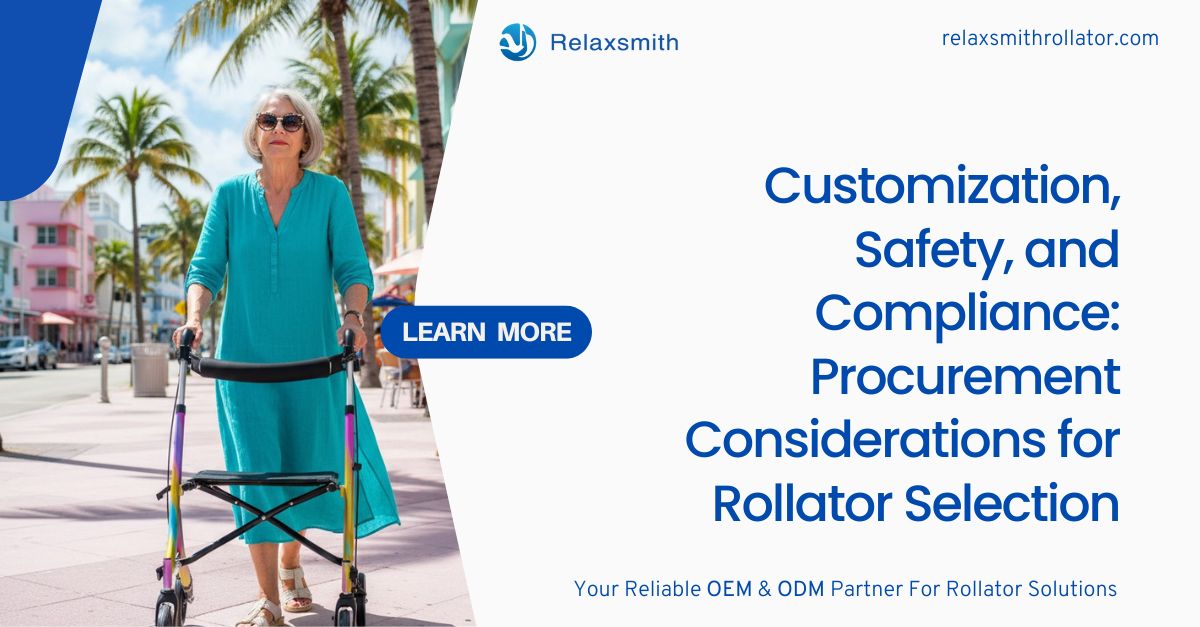
Customization, Safety, and Compliance: Procurement Considerations for Rollator SelectionCustomization, Safety, and Compliance: Procurement Considerations for Rollator Selection
In today’s healthcare landscape, the procurement of mobility aids—especially rollators—requires a deep understanding of compliance, safety, and the evolving needs for product customization. For supply chain managers and product professionals, selecting between 3-wheeled and 4-wheeled rollators is about far more than initial price or features. This comprehensive guide examines the procurement journey through the lens of regulatory requirements, risk management, and advanced options like the lightweight custom 3-wheeled rollator walker design for seniors.
1. Regulatory Compliance: Global Standards and Local Laws
Compliance is non-negotiable for institutional buyers. Rollators intended for medical use in hospitals, clinics, or senior care facilities must meet strict standards, such as:
ISO 11199, EN 12182: International and European benchmarks for mobility aids.
CE Marking & FDA Approval: Required for devices marketed in Europe and the US, respectively.
Technical documentation: Dossiers on materials, safety, risk assessment, and batch traceability.
Procurement teams should request full documentation during the tender phase. Reputable suppliers of the lightweight custom 3-wheeled rollator walker design for seniors will readily supply compliance certificates, clinical evaluation data, and post-market surveillance protocols.
2. Safety and Risk Management
Beyond compliance, procurement must focus on real-world safety, especially in high-risk populations. Consider:
Structural safety: Sturdiness, anti-tip protection, locking brakes, and secure folding mechanisms.
User training: Some rollators—such as advanced 3-wheeled designs—require specific end-user instruction or demonstration.
Warranty and recall procedures: Clear after-sales support, spare parts provision, and recall communication protocols are essential for managing long-term risk.
3. Product Customization and Specification Management
The trend toward customized mobility solutions is growing. The lightweight custom 3-wheeled rollator walker design for seniors is a prime example, offering:
Custom dimensions (height, width, handle grips)
Accessories: trays, baskets, cane holders, branded labeling
Material upgrades (e.g., carbon fiber, aircraft aluminum for lighter weight)
Special safety options (enhanced brakes, reflective details, reinforced frames)
Effective procurement involves a rigorous specification sheet, formal change management for modifications, and supplier sign-off on final sample prior to mass production.
4. Procurement Workflow: From Tender to Delivery
Professional buyers should standardize each step:
Pre-qualification: Vet vendors for compliance, audit history, and supply capability.
Technical evaluation: Compare user testing data, product certifications, and custom options.
Tender documentation: Detail every compliance, safety, and customization requirement; require proof from bidders.
Sample review and pilot testing: Implement clinical testing with real users before bulk order approval.
Contract negotiation: Cover warranty terms, after-sales service, and regulatory documentation in contracts.
5. Post-Procurement: Quality Assurance and Compliance Monitoring
Ongoing quality control is essential for risk mitigation and regulatory audit-readiness:
Batch and serial tracking for rapid recall if necessary
Documentation archiving: compliance certificates, technical files, training materials
Feedback loops from end-users to supplier for continuous improvement
Conclusion: The Strategic Role of Customization and Compliance
The procurement of rollators is now a complex, strategic process that intertwines safety, regulatory obligations, and a growing demand for customized solutions. Whether choosing a 3-wheeled or 4-wheeled model, and especially when considering advanced options like the lightweight custom 3-wheeled rollator walker design for seniors, only a robust workflow will ensure devices are safe, compliant, and truly fit for purpose.
SEO Keyword Suggestions (40)
rollator complianceprocurement strategy3-wheeled rollator safety4-wheeled rollator compliancelightweight custom 3-wheeled rollator walker design for seniorsmedical device regulationsbuyer checklistrisk managementcustom rollatorhealthcare supply chainsafety certificationprocurement workflowclinical approvalproduct customizationuser safetyISO standard walkerEN 12182FDA rollatorCE certificationtender preparationsafety documentationclinical trials mobility aidafter-sales complianceergonomic rollator designsupply contract negotiationpost-market surveillancerisk assessmentrollator recalldevice labelingproduct traceabilityregulatory auditwarranty documentationproduct registrationtechnical documentationbatch trackingend-user trainingsupplier compliancehealthcare standardsconformity declarationcompliance auditquality management
Tag Suggestions (20)
compliancecustomizationsafetyprocurementrisk managementbuyer guidecertificationclinical approvaluser safetytender processproduct testingcontract managementsupplier auditafter-salestraceabilitytechnical filesergonomicsrollator innovationproduct managerquality management
READ MORE: