How to Evaluate and Select OEM Partners for Mobility Aid CustomizationHow to Evaluate and Select OEM Partners for Mobility Aid Customization
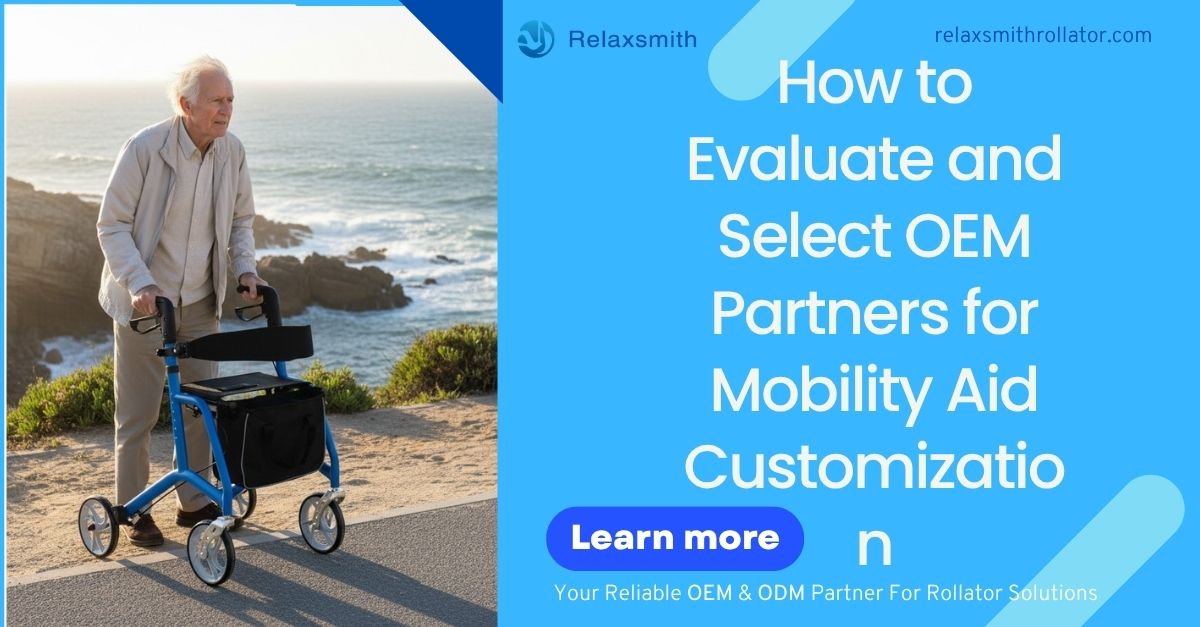
For product managers, procurement leads, and supply chain professionals in the mobility aid sector, selecting the right Original Equipment Manufacturer (OEM) partner is critical. An effective OEM partnership ensures smooth customization, compliance, and delivery of high-quality mobility aids tailored for your market. This article presents a Step-by-Step: The OEM Customization Process for Mobility Aids — with practical strategies to help you make informed decisions when evaluating and selecting OEM partners.
1. Define Your Customization Objectives
Clarify your product requirements, such as design, materials, functionalities, and target end-users (e.g., elderly, patients, hospitals, rehab centers).
List must-have certifications, compliance standards, and regional regulatory needs (FDA, CE, ISO13485, etc.).
Determine your expected order volume, lead time, and delivery locations.
2. Research Potential OEM Partners
Identify manufacturers with proven experience in mobility aids and relevant OEM customization cases.
Review company profiles, production capabilities, and technology expertise.
Gather references from industry peers or check public reviews/case studies.
3. Conduct Initial Due Diligence
Request company certificates, compliance documentation, and test reports.
Evaluate quality control systems and inspection processes in place.
Assess their supply chain reliability, raw material sources, and contingency plans.
4. Communication and Technical Alignment
Ensure the OEM team can communicate effectively in your business language (English, Chinese, etc.).
Discuss their engineering support for customizations and prototyping.
Clarify expectations on technical drawings, specifications, and design iterations.
5. Pilot Orders and Sample Validation
Start with a small batch or prototype run to validate product quality and compliance.
Test samples internally and with end-users for feedback.
Iterate quickly if adjustments are needed to meet market expectations.
6. Site Audits and Ongoing Evaluation
If possible, visit the OEM’s facilities for on-site audits and process review.
Assess manufacturing best practices, quality management, and environmental responsibility.
Establish ongoing evaluation metrics (e.g., defect rate, on-time delivery, communication responsiveness).
7. Risk Management and Contracts
Negotiate clear contracts covering intellectual property, penalties for late delivery, and confidentiality.
Establish backup plans or dual sourcing for critical supply chain continuity.
Define escalation paths and key account contacts for fast issue resolution.
8. Build Long-Term Partnership Value
Share market insights and feedback with your OEM for mutual improvement.
Explore co-development or joint innovation projects for next-generation mobility aids.
Monitor and periodically review the partnership’s value creation.
Selecting the right OEM is the foundation for a successful Step-by-Step: The OEM Customization Process for Mobility Aids. By following these guidelines, product managers and procurement professionals can avoid costly mistakes, accelerate time-to-market, and deliver superior customized mobility aids for diverse user needs.
In summary, a careful OEM partner evaluation process minimizes risk and maximizes innovation opportunities for your brand. Remember, the Step-by-Step: The OEM Customization Process for Mobility Aids should always be aligned with both current project demands and your organization’s long-term growth goals.
SEO Terms for This Article
Products/Services/Customer Segments (40 groups):
OEM mobility aid partner selection, OEM customization, custom walker manufacturing, custom rollator manufacturing, medical device OEM, mobility OEM B2B, OEM partnership, assistive device customization, wheelchair OEM, rollator OEM, elderly mobility OEM, rehab product OEM, procurement strategies, product development OEM, product testing OEM, OEM negotiation, OEM supplier audit, mobility aid sourcing, OEM project management, supply chain risk, OEM logistics, OEM design for mobility, OEM order process, OEM client support, innovation in mobility aids, new product launch OEM, regulatory compliance OEM, OEM technical support, supply chain efficiency, OEM lead time, OEM communication, B2B mobility device, OEM product validation, custom product solutions, professional procurement OEM, product manager mobility aids, supply chain manager, procurement manager, OEM due diligence, quality control OEM, OEM compliance, step-by-step OEM
SEO Keywords (Sample 6):
OEM mobility aid partner selection, OEM customization, medical device OEM, mobility OEM B2B, OEM partnership, assistive device customization
Summary
This article provides a structured roadmap for B2B professionals to evaluate and select OEM partners for mobility aid customization. From clarifying project objectives and vetting potential manufacturers to conducting audits and managing supply chain risks, every step is designed to ensure successful outcomes and high customer satisfaction. By applying these best practices, product managers and procurement teams can gain a competitive edge in the mobility aids market.









