.png)
Quality Assurance and Testing in OEM Mobility Aid Projects: A Practical GuideQuality Assurance and Testing in OEM Mobility Aid Projects: A Practical Guide
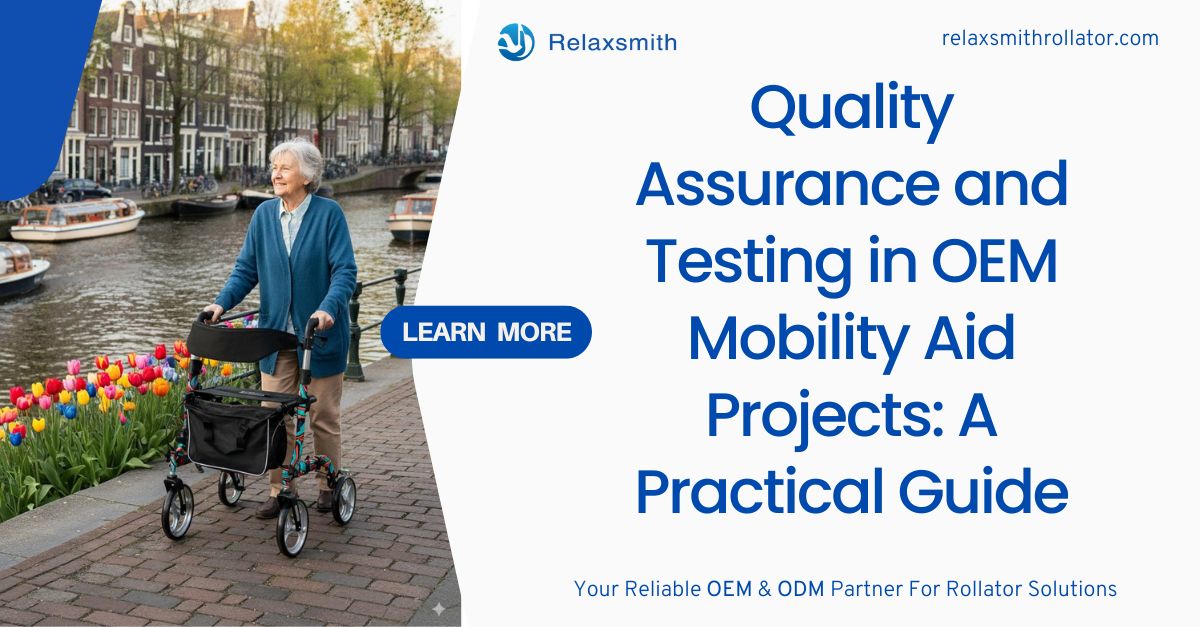
For product managers, procurement leaders, and supply chain professionals overseeing OEM mobility aid projects, robust quality assurance (QA) and testing processes are essential for product safety, regulatory compliance, and customer satisfaction. This article provides a Step-by-Step: The OEM Customization Process for Mobility Aids with a hands-on focus on QA and testing from design to delivery.
1. Define QA Objectives and Regulatory Requirements
Start by identifying all applicable quality standards (e.g., ISO13485, FDA, CE) and market-specific testing protocols for each mobility aid.
Establish clear product acceptance criteria: durability, load capacity, usability, and chemical safety.
Document these QA requirements in the OEM project’s technical files and supply agreements.
2. Supplier Audit and Quality Management System Validation
Audit OEM facilities to ensure effective quality management systems and process controls are in place.
Review records of previous QA issues, corrective actions, and continuous improvement initiatives.
Ensure all production lines are validated and calibrated for repeatable, reliable output.
3. Risk Assessment and Control Planning
Conduct a formal risk assessment (e.g., FMEA) on new mobility aid designs or customizations.
Develop control plans to prevent and detect defects at critical stages—material receipt, in-process, and final inspection.
Involve OEM partners in establishing preventative maintenance schedules for manufacturing equipment.
4. Product Testing Protocols and Sampling
Develop comprehensive testing protocols covering all safety, functionality, and regulatory requirements.
Use statistical sampling for batch inspection and document all test results for traceability.
Conduct third-party or in-house testing for critical functions: load, impact, folding, and locking mechanisms.
5. Defect Prevention, Reporting, and Corrective Actions
Implement real-time defect tracking and immediate containment measures in production.
Use root cause analysis (RCA) and corrective action processes (CAPA) for any nonconformities found.
Maintain open QA communication between OEM and your internal teams for fast resolution.
6. Field Testing, Feedback, and Continuous Improvement
Facilitate pilot user programs to validate product usability and collect real-world feedback.
Analyze return and warranty data to identify recurring issues and drive design improvements.
Schedule regular performance reviews and improvement workshops with OEM partners.
Applying a Step-by-Step: The OEM Customization Process for Mobility Aids approach to quality assurance and testing empowers B2B teams to deliver safe, effective, and compliant products. By making QA a collaborative, data-driven process, organizations can minimize risks, satisfy customers, and strengthen OEM partnerships for future growth.
In today’s highly regulated and competitive market, a well-structured QA and testing system is not just best practice—it’s essential for business success.
SEO Terms for This Article
Products/Services/Customer Segments (40 groups):
OEM quality assurance, product testing, mobility aid QA, B2B mobility aids, testing protocol OEM, inspection criteria, regulatory testing, quality management system, ISO13485, risk assessment OEM, compliance testing, defect prevention, root cause analysis, OEM supplier audit, testing documentation, product validation, production sampling, user safety testing, custom walker testing, rollator QA, wheelchair testing OEM, OEM technical support, test reporting, corrective action process, reliability testing, QA checklist OEM, supplier development, traceability OEM, regulatory compliance QA, quality gates OEM, third-party testing, incoming inspection, production monitoring, test data management, field testing, OEM warranty process, end-user feedback QA, continuous improvement OEM, OEM performance review, step-by-step OEM
SEO Keywords (Sample 6):
OEM quality assurance, product testing, mobility aid QA, regulatory testing, quality management system, product validation
Summary
This guide equips product managers and procurement professionals with step-by-step strategies for robust QA and testing throughout the OEM customization process for mobility aids. Covering audits, risk assessment, testing, defect management, and continuous improvement, it provides actionable tools for ensuring B2B success in the mobility aids sector.
READ MORE: