



Rollators are often used daily for years, especially among older adults with chronic mobility limitations. While initial selection focuses on stability and comfort, long-term durability is equally critical. Wear and tear over time can gradually reduce braking efficiency, wheel traction, and structural stability—factors that directly influence safety outcomes.
According to general findings in geriatric mobility care and assistive device maintenance studies, mechanical degradation is one of the most common causes of reduced performance in mobility aids used beyond 12–24 months without proper inspection or maintenance routines. While not always leading to immediate failure, gradual wear can increase the likelihood of instability, delayed braking response, or uneven movement.
A caregiver shared a practical observation:
"We didn’t notice the brake weakening until the rollator started sliding slightly on a slope. It wasn’t a sudden failure—it was gradual wear that became a safety concern over time."
This highlights a key principle in mobility aid management: long-term safety depends not only on design quality, but also on durability and maintenance visibility.
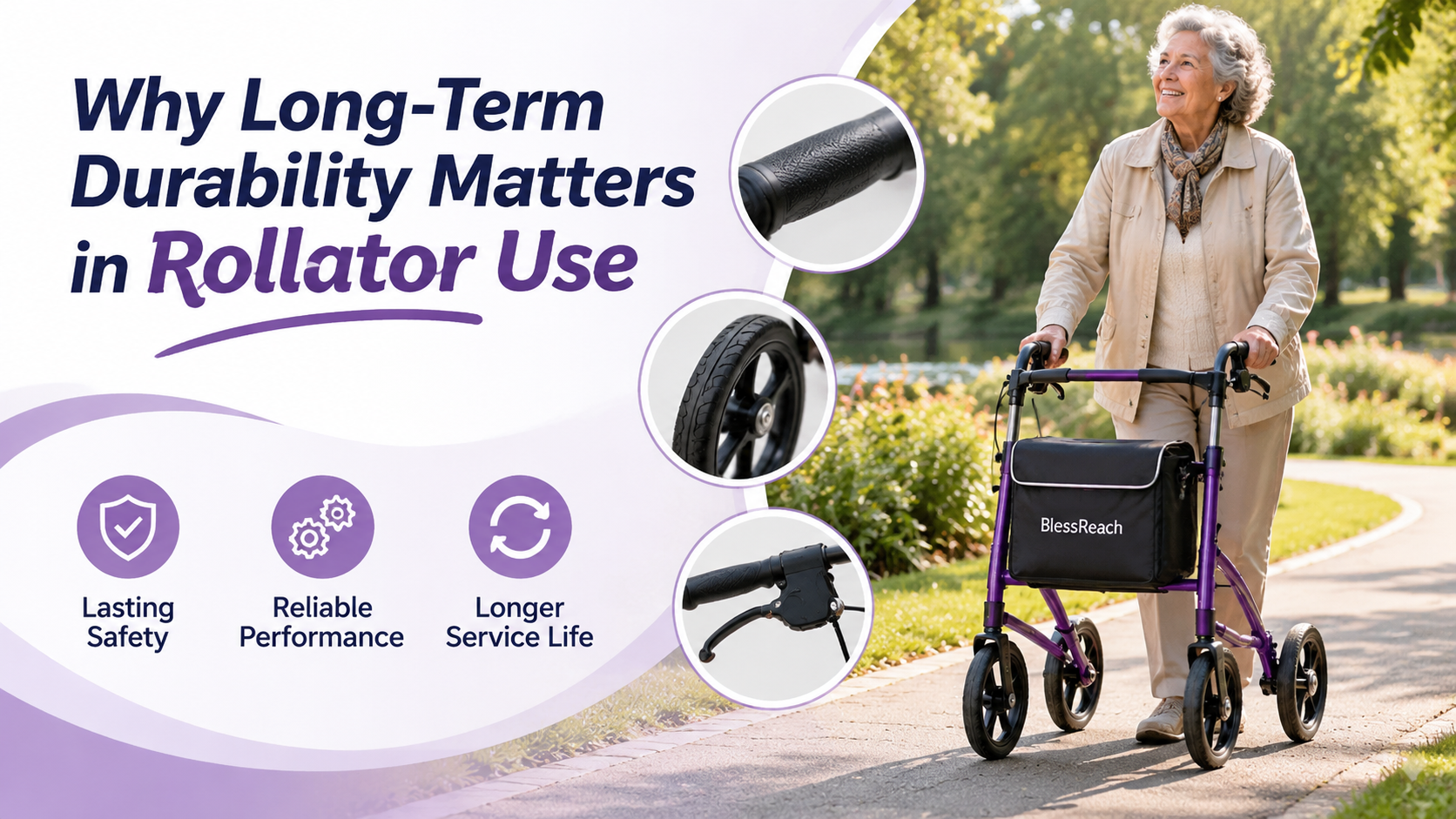
Why Long-Term Durability Matters in Rollator Use
Unlike short-term medical equipment, rollators are frequently used as long-term mobility companions. Many seniors rely on them for most daily movement—indoors, outdoors, and during rehabilitation activities. This continuous usage exposes the device to repetitive mechanical stress.
Key challenges over time include:
· Repeated load stress on frame joints
· Wheel abrasion from different surface types
· Brake cable tension loss or misalignment
· Grip material aging and surface degradation
· Fastener loosening due to vibration and frequent folding
These issues do not usually appear suddenly. Instead, they develop gradually, often going unnoticed until performance is affected.
A rehabilitation clinician explained:
"The risk is not just equipment failure—it’s performance drift. A rollator can still look intact but behave less safely than when it was new."
Common Wear-and-Tear Risks in Rollators
Structural fatigue
Over time, repeated weight-bearing and folding cycles can create micro-stress in frame joints. While modern aluminum or steel alloys are designed for durability, long-term use without inspection can still lead to reduced rigidity.
Wheel degradation
Wheels are one of the most frequently worn components. Smooth indoor floors, outdoor asphalt, and uneven terrain all contribute to surface abrasion. Reduced tread quality can affect traction and increase slipping risk.
Brake system wear
Brake cables and pads are critical safety components. With extended use, cable tension may loosen, and braking response may become less consistent. This is one of the most safety-sensitive degradation points.
Handle grip deterioration
Grip materials may harden, crack, or lose friction over time. This affects control and increases upper-limb fatigue.
Loose adjustment mechanisms
Height adjustment systems may gradually lose locking precision due to repeated changes, especially in shared or frequently adjusted devices.
Safety Risks Linked to Long-Term Wear
When wear is not addressed, it can lead to several functional safety issues:
· Reduced braking reliability on slopes or uneven ground
· Instability during directional changes
· Increased effort required for control, leading to fatigue
· Higher risk of slipping due to worn wheels
· Reduced user confidence, leading to decreased mobility activity
A physical therapist noted:
"Even small changes in rollator performance can influence gait stability. Seniors often compensate unconsciously, which can increase fall risk."
This compensation behavior is particularly important. Users may lean more heavily, slow down excessively, or avoid certain environments—all of which can reduce independence over time.
Design Features That Improve Long-Term Durability
To ensure long-term safety, rollator design must go beyond initial performance and incorporate durability-focused engineering.
High-strength frame construction
Aluminum alloys and reinforced joint structures help maintain rigidity under repeated load cycles. Weld quality and stress distribution design play a critical role in long-term performance stability.
Wear-resistant wheels
High-density rubber or polyurethane wheels improve abrasion resistance. Larger diameter wheels also help distribute load and reduce surface impact stress.
Reliable braking systems
Dual-action braking systems and reinforced cable pathways help maintain consistent performance over time. Easy adjustment mechanisms allow maintenance without full disassembly.
Ergonomic, long-life grips
Anti-aging materials with moisture and friction resistance improve grip longevity and user comfort.
Modular replaceable components
Designing wheels, grips, and brake systems as replaceable modules significantly extends product lifespan and reduces long-term safety risks.
Stable locking mechanisms
Improved folding and height adjustment systems reduce loosening over time and maintain consistent structural alignment.
The Role of Maintenance in Long-Term Safety
Even well-designed rollators require regular inspection to ensure safe operation. Simple maintenance routines can significantly reduce risk:
· Checking brake responsiveness periodically
· Inspecting wheel wear and rotation smoothness
· Ensuring frame joints remain tight and stable
· Verifying handle grip integrity
· Testing locking mechanisms before use
A caregiver shared:
"Once we started doing monthly checks, we noticed small issues early—like brake tension changes—before they became real safety problems."
This highlights an important reality: durability is not only a manufacturing issue, but also a lifecycle management issue.
Procurement and Healthcare System Considerations
For hospitals, rehabilitation centers, and senior care facilities, durability should be a core procurement criterion rather than an afterthought. Key considerations include:
· Verified long-term load testing data
· Replaceable wear components availability
· Standardized maintenance protocols
· Brake system durability ratings
· Wheel material specifications for mixed terrain use
· Warranty coverage that reflects real usage cycles
A healthcare procurement specialist summarized it clearly:
"The cost of a rollator is not just the purchase price—it’s the long-term safety performance and maintenance reliability."
Summary
Long-term rollator use requires a balance between design quality, material durability, and maintenance practices. Over time, wear and tear can affect braking, stability, and control—directly influencing user safety.
Effective solutions combine:
· Durable structural design
· Wear-resistant wheels and components
· Reliable braking systems
· Modular replaceable parts
· Routine maintenance practices
When these elements work together, rollators remain safe and effective throughout their lifecycle, supporting sustained independence for seniors.
As one rehabilitation professional summarized:
"A rollator is not a one-time device—it is a long-term mobility system. Its safety depends on how well it performs over time, not just on day one."
For more information about Mobility rollator solutions, feel free to contact us:
🌐 Learn more: www.RelaxsmithRollator.com
📱 WhatsApp / Wechat: +86 1781 6801 959
📧 Email: relaxsmith@smartelderlycare.com