



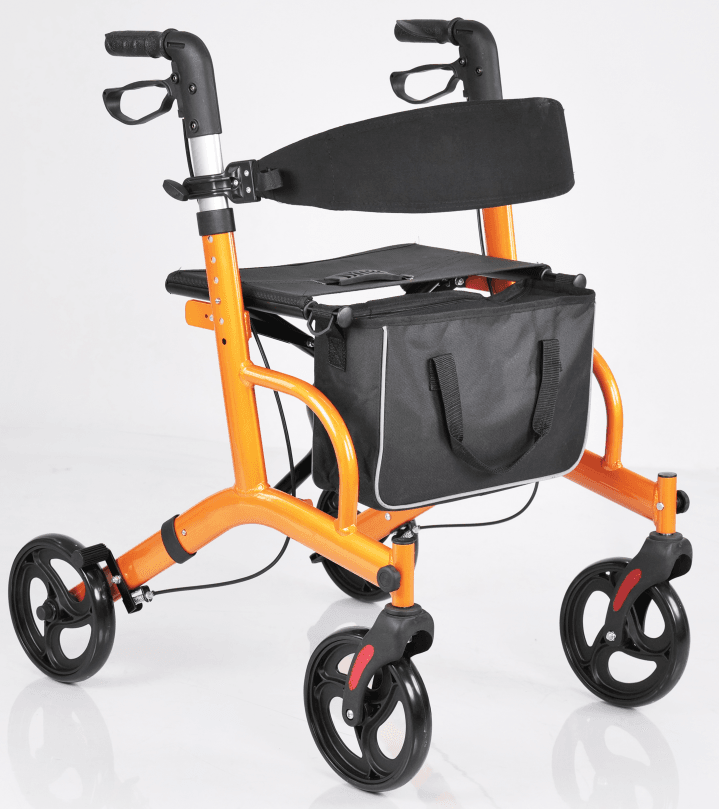
Supply Chain Benefits of Standardizing on Walker with Detachable Seat Cushion: Easy to Clean and Maintain
In modern healthcare operations, supply chain management is not only about cost control—it is about ensuring safety, compliance, operational efficiency, and patient satisfaction. Mobility aids such as walkers represent a significant portion of procurement budgets and operational workflows in hospitals, eldercare facilities, and rehabilitation centers. Standardizing on the Walker with Detachable Seat Cushion: Easy to Clean and Maintain provides supply chain managers with a comprehensive solution that balances hygiene, cost-effectiveness, and cross-departmental efficiency.
This article explores how supply chain professionals, procurement managers, and product managers can leverage this walker to enhance institutional performance, reduce risk, and create long-term strategic value.
1. Standardization as a Supply Chain Strategy
Standardization in supply chains refers to reducing variability in product lines to simplify logistics, procurement, and inventory management. By adopting a single, versatile product such as the Walker with Detachable Seat Cushion: Easy to Clean and Maintain, institutions benefit from reduced SKU complexity, simplified warehousing and distribution, and consistency across multiple care settings.
Supply chain professionals can reduce ordering errors, optimize storage space, and minimize training requirements for staff when standardized products are deployed system-wide.
2. Hygiene Integration and Compliance Support
In healthcare supply chains, hygiene is not optional—it is a non-negotiable requirement. Walkers with fixed seat cushions require extensive cleaning protocols, consuming both time and labor.
The detachable cushion design allows for quick removal, washing, and disinfection, which directly supports infection control measures. By standardizing on this design, supply chain managers ensure compliance across institutions, reducing risks of fines, penalties, or reputational damage during audits.
3. Lifecycle Cost Savings
Total Cost of Ownership (TCO) is a critical measure in supply chain decisions. While a walker with detachable cushions may have a higher upfront cost than a basic alternative, its lifecycle benefits significantly outweigh this initial expense.
Detachable cushions can be replaced independently, extending the walker’s overall lifespan. This reduces procurement frequency, cuts maintenance labor, and lowers waste disposal costs. When multiplied across thousands of units, these savings represent substantial value for healthcare networks.
4. Procurement Efficiency and Vendor Consolidation
Standardizing on the Walker with Detachable Seat Cushion: Easy to Clean and Maintain simplifies procurement contracts. Institutions can negotiate larger bulk orders with fewer vendors, achieving economies of scale and improving supplier relationships.
Vendor consolidation reduces administrative overhead, enhances bargaining power, and simplifies compliance checks. Procurement managers can also track performance metrics more effectively when fewer product variations are in use.
5. Logistics and Distribution Optimization
Logistics efficiency depends on uniform packaging, predictable dimensions, and standardized handling procedures. Walkers with detachable cushions meet these requirements by reducing the need for additional accessories or packaging variations.
Palletization: Standardized units allow for optimized freight configurations. Distribution: Uniformity simplifies shipment to multiple facilities. Inventory management: Barcoding and digital tracking are easier with standardized products.
This streamlining reduces logistics costs and minimizes the risk of distribution errors.
6. Warehouse Management and Storage Efficiency
In large healthcare systems, warehouses handle thousands of mobility aids. SKU diversity complicates inventory management and increases the likelihood of fulfillment errors.
By standardizing on a walker with detachable cushions, institutions reduce SKU counts and simplify order fulfillment. The high-visibility design of cushions also makes identification easier during storage, minimizing picking errors and improving throughput efficiency.
7. Reverse Logistics and Returns Management
Reverse logistics, including product returns, replacements, and warranty claims, represent a hidden cost in supply chains. Walkers with poor hygiene performance or high replacement rates drive up these costs.
The Walker with Detachable Seat Cushion: Easy to Clean and Maintain reduces dissatisfaction and product failure rates, lowering return volumes. This strengthens institutional reputation and reduces costly processes associated with reverse logistics.
8. Cross-Departmental Collaboration
Supply chains intersect with multiple departments. Standardized hygiene-friendly walkers provide benefits across the board: Caregivers spend less time cleaning and more time on patient care. Administrators gain predictable costs and better compliance records. Warehouse teams manage fewer SKUs and streamline distribution.
This cross-departmental alignment ensures that supply chain decisions contribute to overall institutional success.
9. Digital Supply Chains and Data Tracking
Healthcare supply chains are rapidly adopting digital tools such as barcoding, IoT sensors, and real-time inventory tracking. Standardizing on a walker with detachable cushions supports these efforts by ensuring product consistency across datasets.
Digital systems can track product lifecycles, usage rates, and hygiene outcomes, providing supply chain managers with actionable data. This supports predictive analytics, improves decision-making, and enhances long-term planning.
10. Risk Mitigation and Insurance Implications
Institutions face liability risks if products fail hygiene standards or contribute to patient accidents. Insurance providers assess institutional risk profiles when determining premium rates.
By adopting hygiene-oriented walkers, institutions demonstrate proactive risk management. Over time, this can reduce insurance costs, strengthen institutional resilience, and mitigate potential legal liabilities.
11. International Supply Chain Advantages
For healthcare groups operating across multiple countries, standardization simplifies global procurement. The Walker with Detachable Seat Cushion: Easy to Clean and Maintain meets universal concerns of hygiene and maintenance, making it adaptable across diverse regulatory environments.
This reduces the need for region-specific product variations and supports global supply chain scalability.
12. Strategic Sustainability
Sustainability is an emerging priority in healthcare procurement. Products that reduce waste, extend lifespans, and minimize labor contribute to institutional sustainability goals.
By replacing only cushions instead of entire walkers, institutions reduce material waste and environmental impact. This strengthens corporate social responsibility initiatives and improves institutional reputation with stakeholders.
13. Case Example: Large-Scale Supply Chain Benefits
A hospital network with 20 facilities standardized on the Walker with Detachable Seat Cushion: Easy to Clean and Maintain. Within two years, they achieved: A 35% reduction in total walker procurement costs, a 20% improvement in logistics efficiency due to standardized shipments, a 30% reduction in returns and warranty claims, and improved staff satisfaction scores related to cleaning and handling.
This example demonstrates how supply chain standardization yields measurable operational and financial benefits.
Conclusion
Standardizing on the Walker with Detachable Seat Cushion: Easy to Clean and Maintain is not merely a purchasing decision—it is a supply chain strategy that enhances efficiency, reduces costs, mitigates risks, and improves patient outcomes.
For supply chain managers, procurement specialists, and product managers, the benefits extend beyond operational savings to include compliance support, sustainability, and institutional reputation. By prioritizing hygiene-focused standardization, institutions create long-term resilience in increasingly complex healthcare environments.
40 SEO Keywords
walker supply chain efficiency, walker procurement standardization, walker with detachable cushion supply chain, walker logistics optimization, walker warehouse efficiency, walker procurement lifecycle savings, walker reverse logistics reduction, walker supply chain resilience, walker compliance supply chain, walker procurement scalability, walker supply chain digital tracking, walker procurement vendor consolidation, walker supply chain cost savings, walker procurement logistics performance, walker inventory optimization, walker supply chain standardization strategy, walker procurement in healthcare, walker logistics and compliance, walker supply chain innovation, walker risk management supply chain, walker global procurement efficiency, walker supplier consolidation benefits, walker warehouse throughput improvement, walker procurement TCO savings, walker sustainability in supply chain, walker procurement performance metrics, walker standardized procurement logistics, walker reverse logistics optimization, walker procurement operational efficiency, walker warehouse process simplification, walker supply chain adaptability, walker supply chain compliance support, walker procurement data-driven insights, walker international supply chain benefits, walker cost savings in logistics, walker supply chain with detachable cushions, walker procurement strategic alignment, walker healthcare supply chain resilience, walker standardized product procurement, walker supply chain sustainability strategy
READ MORE:
- Design and UX Insights: Adjustable Rollator with Multi-Position Backrest
- Supply Chain Advantages of Adjustable Rollator with Multi-Position Backrest
- Cost-Benefit Analysis of Medical Walker with Quick Folding Action
- Design and UX Insights: Medical Walker with Quick Folding Action
- Supply Chain Advantages of Medical Walker with Quick Folding Action
- Procurement Considerations for Medical Walker with Quick Folding Action
- How Medical Walker with Quick Folding Action Improves Patient Mobility
- Cost-Benefit Analysis of Walker with Detachable Seat Cushion
- Design and Maintenance Insights: Why Walker with Detachable Seat Cushion Matters to Product Managers