





.JPG)
User-Driven Innovation: What Tr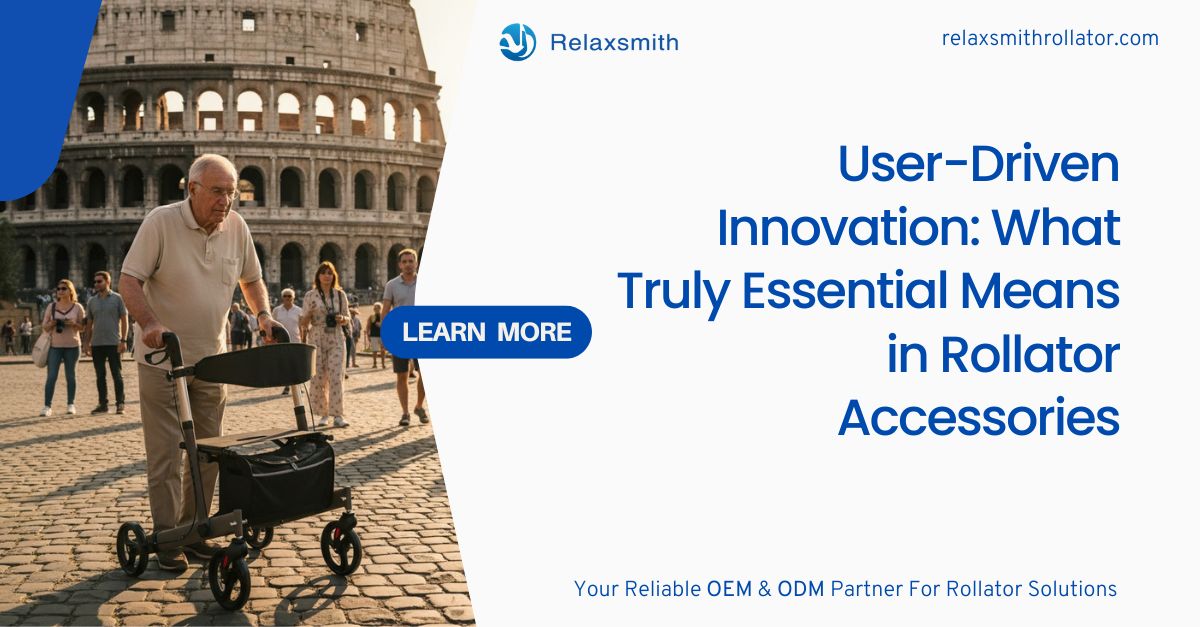 uly Essential Means in Rollator Accessories
Across the mobility industry, teams are learning that what makes a rollator accessory truly essential is determined not in a lab, but in the hands of users. Procurement professionals and product developers are increasingly relying on actual usage data and end-user interviews to define their product roadmaps and procurement logic.
1. Observing Daily Contexts
Essential accessories are not those that look good in a catalog but the ones that improve user lives in everyday moments:
A tray that allows breakfast in the garden
A hook that carries a bag during a pharmacy trip
A pouch for safely storing a wallet or ID card
Data from assisted living facilities reveals which items show the highest usage and satisfaction scores.
2. Language of Simplicity and Trust
When users describe what makes a rollator accessory truly essential, they often use words like “reliable,” “easy,” and “makes life smoother.” These responses point to low-friction interfaces—no zippers too small, no buttons too stiff. Design empathy converts these observations into essential products.
3. The Feedback Loop
Brands that integrate open feedback channels (QR code surveys, post-sale calls, or in-app prompts) are better equipped to discover underreported pain points. These small signals often guide the evolution from 'optional' to 'essential' features in future versions.
4. Procurement with Empathy
Even with cost constraints, procurement professionals must consider qualitative insights:
Which accessory supports emotional wellness?
Which accessory contributes to perceived independence?
Which accessory sees fewer returns and repairs?
Conclusion: Grounding Strategy in Real Experience
True innovation arises from deep listening. By aligning engineering, design, and procurement with firsthand user narratives, organizations can finally answer what makes a rollator accessory truly essential—and build portfolios that reflect daily dignity, not just theoretical need.
SEO Keywords (40 groups)
user-driven mobility design
real world rollator accessory
feedback led product planning
walker empathy design
essential assistive tech
inclusive mobility products
rollator user stories
human-centered mobility
walker add-on impact
walker lifestyle enhancement
rollator user testimonials
accessory usage data
practical walker gear
assistive listening accessories
procurement empathy model
elderly mobility support
design for usability
everyday essential walker
assistive needs analysis
mobility behavior insight
adaptive accessory development
lived experience mobility aid
walkers with feedback integration
low friction walker tools
rollator accessory innovation
emotional benefit gear
reduced return accessory
walker add-on ROI
assistive gear feedback
accessory research walker
person-first mobility tool
smart walker design
accessory simplicity factor
trust-based mobility upgrade
daily usage walker accessories
adaptive accessory sourcing
lifestyle-centric mobility
voice of customer mobility
quality of life walker item
essential walker upgrade
Tags:
user-driven mobility design, real world rollator accessory, walker lifestyle enhancement, inclusive mobility products, rollator user stories, empathy design, low friction walker tools, adaptive accessory sourcing, essential walker upgrade, accessory usage data