



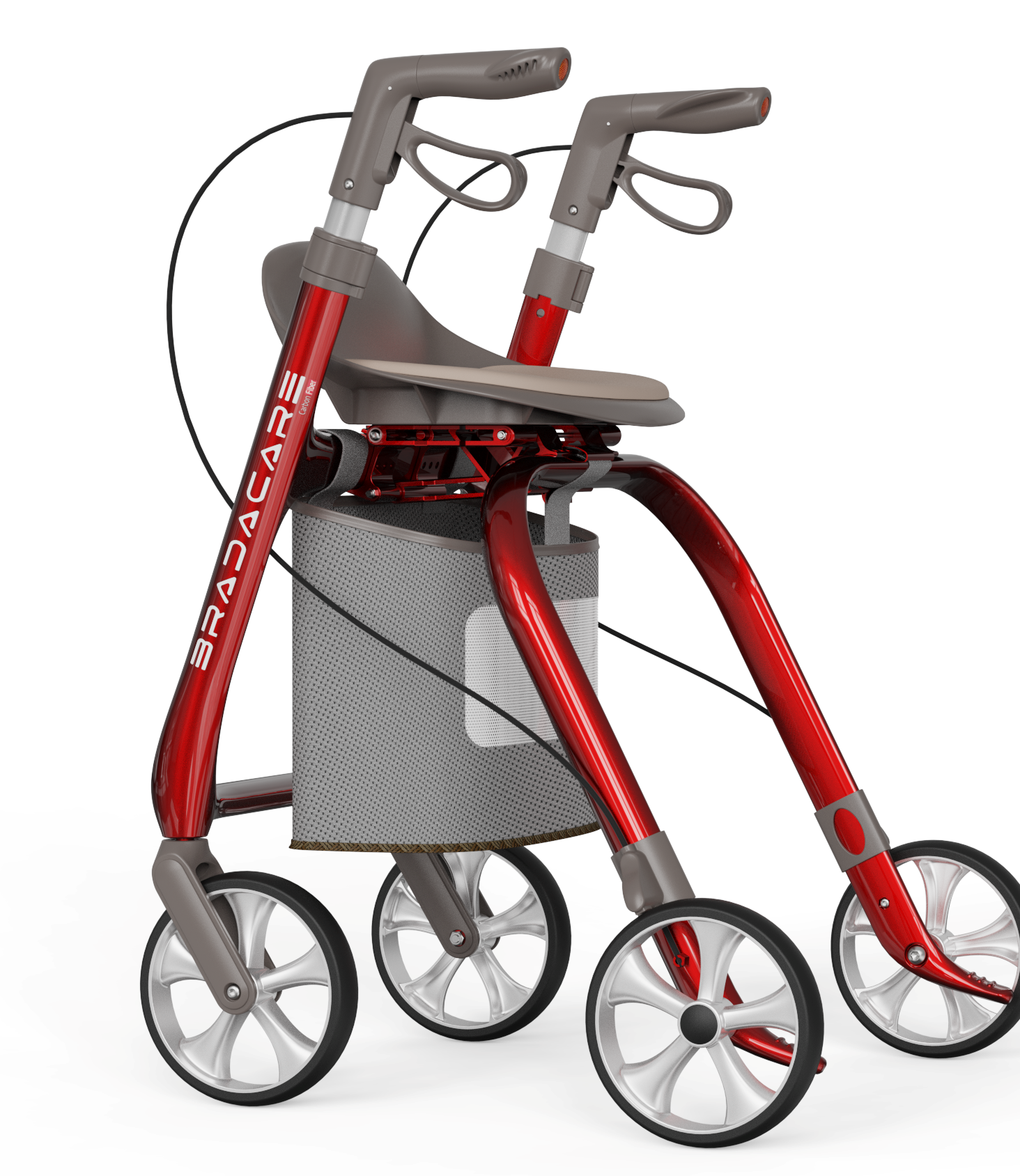
Traditional Rollator Designs vs. Ergonomic Alternatives
Exploring Functional and Strategic Differences for Industry Decision-Makers
Introduction: The Evolving Landscape of Mobility Design
The medical mobility sector is rapidly redefining what it means to build accessible, efficient, and user-friendly walking aids.
While traditional rollator designs have long been valued for their simplicity and low cost, ergonomic alternatives are reshaping how professionals approach product development and procurement strategy.
This evolution poses key questions for supply chain leaders and product managers:
How do ergonomic rollators differ in function, design, and operational impact? And how should organizations adapt to these changes?
Traditional Rollator Designs: Proven but Limited
For decades, the traditional rollator has set the industry standard.
Its rigid frame, fixed handle positions, and basic wheel mechanisms prioritize reliability over innovation.
These models excel in mass production due to their predictable component structure and wide supplier availability.
However, the limitations of traditional rollators have become more pronounced as healthcare institutions and end-users demand higher levels of comfort, adaptability, and aesthetics.
From a procurement perspective, the traditional rollator’s advantages include low unit cost, quick assembly, and compatibility with existing logistics systems.
Yet, the lack of ergonomic adaptability can lead to lower satisfaction rates among users—particularly elderly patients with posture sensitivity or arthritis.
Ergonomic Rollator Alternatives: Innovation in Motion
Ergonomic rollators emphasize human-centered engineering.
They feature contoured handles, posture-corrective frames, and adjustable height mechanisms.
Beyond comfort, these innovations contribute to enhanced balance, reduced fatigue, and better rehabilitation outcomes for patients.
The introduction of lightweight materials such as carbon fiber and reinforced aluminum has further improved both performance and portability.
For manufacturers and product managers, adopting ergonomic design principles often requires a shift in supply chain dynamics.
Specialized materials, tighter quality control, and precision tooling increase complexity but also differentiate products in a competitive market.
For procurement teams, the challenge lies in sourcing cost-effective yet high-performance components to maintain profitability.
Comparative Evaluation: Traditional vs. Ergonomic Rollators
Design Focus: Traditional rollators prioritize durability; ergonomic rollators focus on user posture and comfort.
Manufacturing Cost: Traditional models offer a 20–30% lower production cost, but ergonomic versions yield higher market value.
Weight: Ergonomic rollators are up to 40% lighter due to advanced material integration.
Maintenance: Traditional rollators use simple mechanical joints, while ergonomic models employ advanced adjustability systems that require periodic calibration.
User Demographics: Ergonomic designs appeal to long-term care facilities and premium markets, while traditional designs serve bulk institutional needs.
Strategic Considerations for Product Managers
Product managers should approach this comparison through data and lifecycle analytics.
Ergonomic rollators may require higher upfront investment but often deliver superior brand positioning and user loyalty.
Market segmentation plays a key role — by identifying niches that value comfort and design innovation, companies can optimize product lines for both performance and profit.
Collaboration with ergonomic specialists during the design phase can significantly reduce post-launch revisions.
Additionally, leveraging user feedback loops from healthcare providers ensures that the final product aligns with practical, clinical needs.
Supply Chain Adaptation: From Standardization to Specialization
Transitioning from traditional to ergonomic rollator production involves rethinking supplier partnerships.
Sourcing high-grade materials such as magnesium alloys or anti-slip handle rubbers demands both traceability and testing rigor.
Supply chain leaders must balance innovation with operational efficiency, implementing just-in-time inventory strategies to mitigate cost inflation.
Additionally, digital twins and predictive analytics tools can help streamline quality assurance processes in ergonomic rollator manufacturing, reducing delays caused by complex assembly tolerances.
Conclusion: A Shift from Function to Experience
The comparison between traditional rollator designs and ergonomic alternatives highlights a broader shift in healthcare manufacturing—from function to experience.
The future belongs to products that combine practicality, design intelligence, and patient well-being.
For decision-makers, the winning strategy lies not in choosing one over the other but in balancing cost-efficiency with innovation.
Organizations that successfully integrate ergonomic thinking into their design and procurement processes will position themselves as leaders in the next generation of mobility solutions.
SEO Keywords (40 sets)
Traditional rollator design comparison, ergonomic alternatives in healthcare, mobility product strategy, rollator supply chain optimization, lightweight rollator manufacturing, healthcare equipment design, senior mobility innovation, product management in medical devices, ergonomic rollator engineering, adjustable handle walker, carbon fiber rollator production, healthcare mobility market analysis, ergonomic posture support, aluminum frame rollator design, modern medical mobility trends, rollator material analysis, product differentiation medical aids, healthcare procurement strategies, compact ergonomic walker, rollator comfort study, patient-centered design, sustainable rollator production, ergonomic grip technology, posture enhancement rollator, advanced healthcare mobility, lightweight ergonomic support, rollator R&D strategy, healthcare mobility supply chain, product innovation for seniors, ergonomic walking technology, medical device sourcing optimization, traditional vs ergonomic comparison, human factors in rollator design, clinical-grade rollator analysis, medical device lifecycle management, adaptive healthcare equipment, rollator ergonomics research, future of mobility aids, supply chain modernization healthcare, manufacturing innovation mobility aids.
Tags (20 sets)
ergonomic rollator, traditional rollator, product management, supply chain innovation, healthcare design, carbon fiber walker, adjustable rollator, lightweight mobility aid, senior care equipment, ergonomic handle design, posture improvement device, modern rollator, healthcare procurement, medical equipment analysis, mobility device strategy, industrial design rollator, innovation in healthcare aids, product lifecycle rollator, ergonomic engineering, supply chain optimization.
READ MORE:





